Infinite Banking · Visualized

IBC without
the spreadsheet.

A spreadsheet holds last month’s numbers. It doesn’t know what you’ve earmarked, that your premium is due, that interest capitalizes at the anniversary, or that PUA room is about to lapse. This does.

Free during early access · No credit card · See how it works
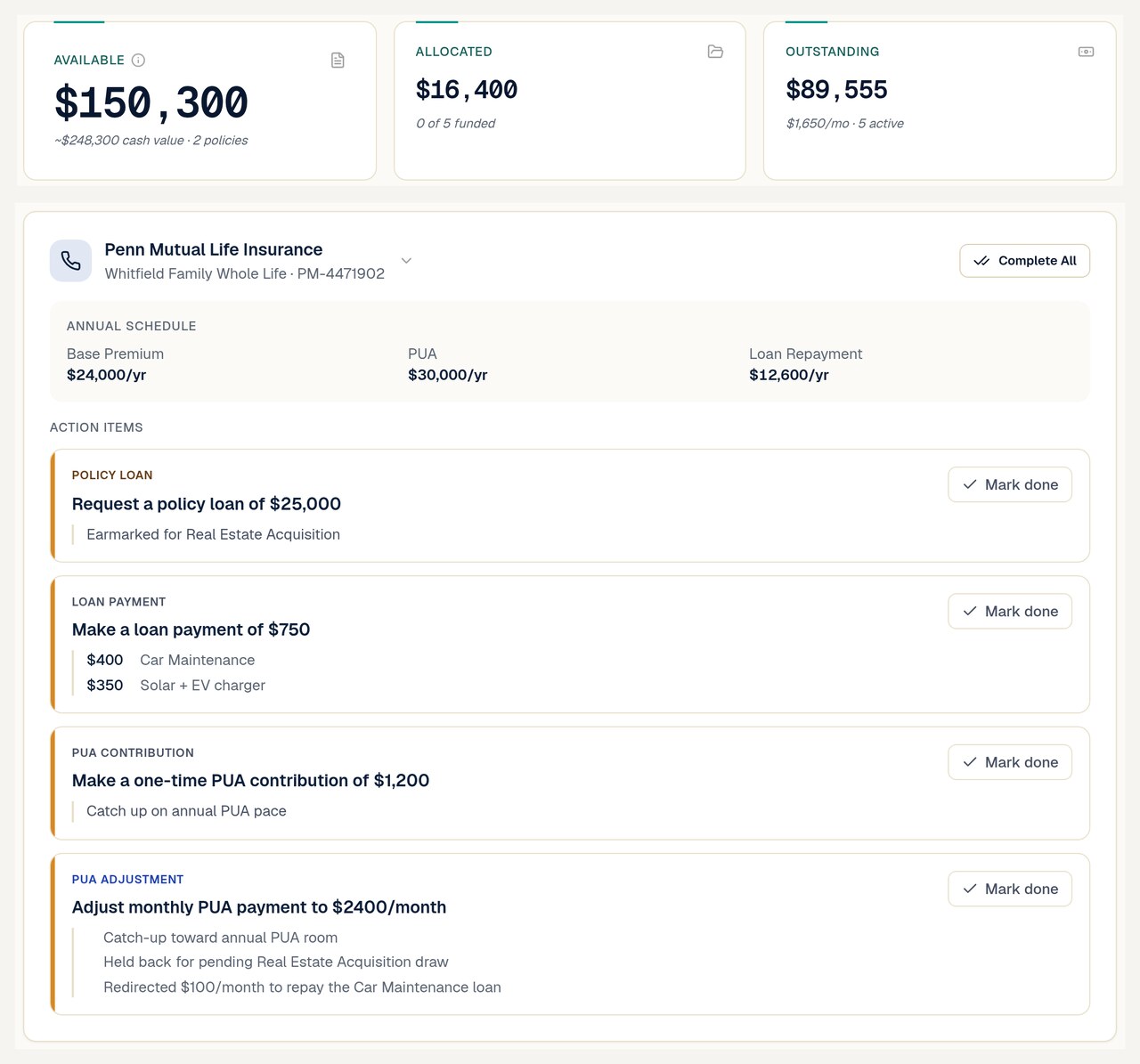
Available, allocated, and outstanding totals, plus this period’s agenda

Every policy, in one place.

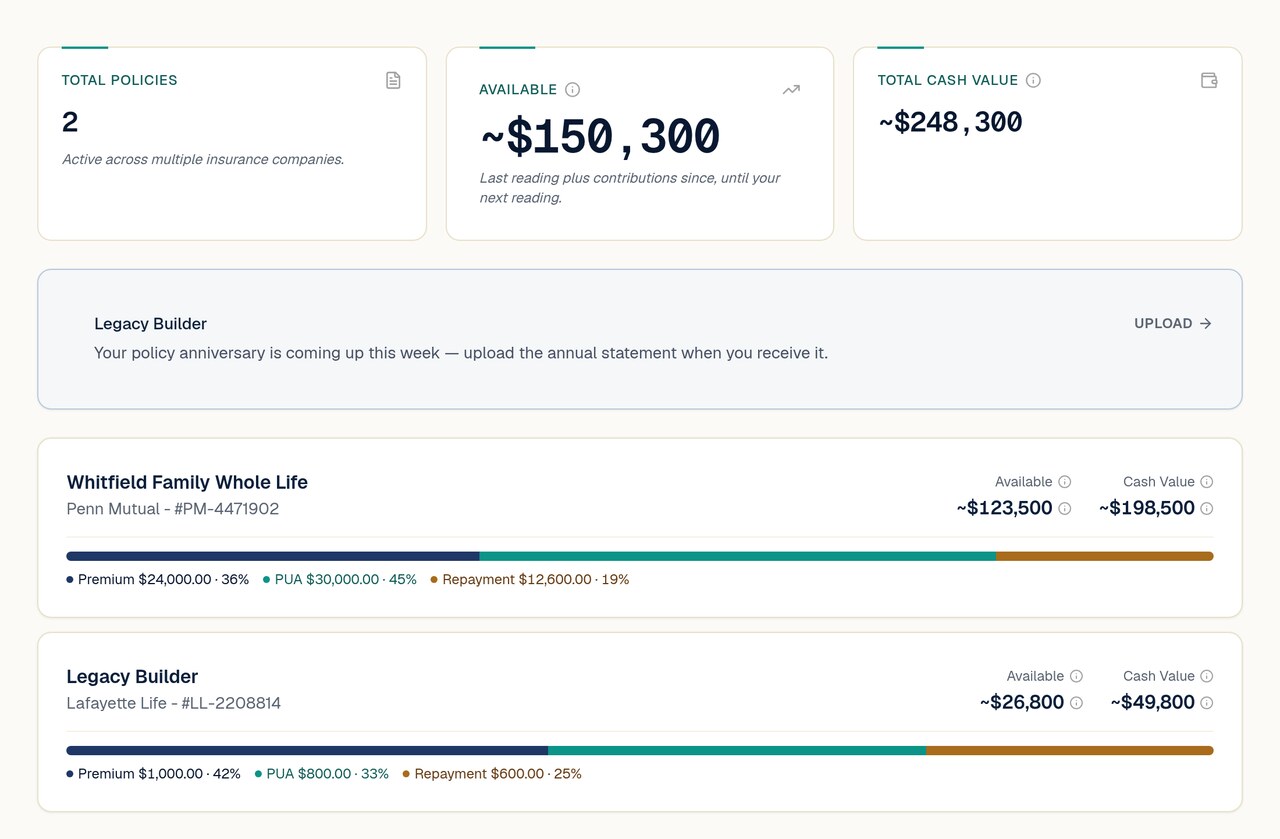
Cash value, loans outstanding, and what you can still borrow — across every policy and every insurance company.

Policies overview with available balance and cash value per policy

Plan by goal, not by policy.

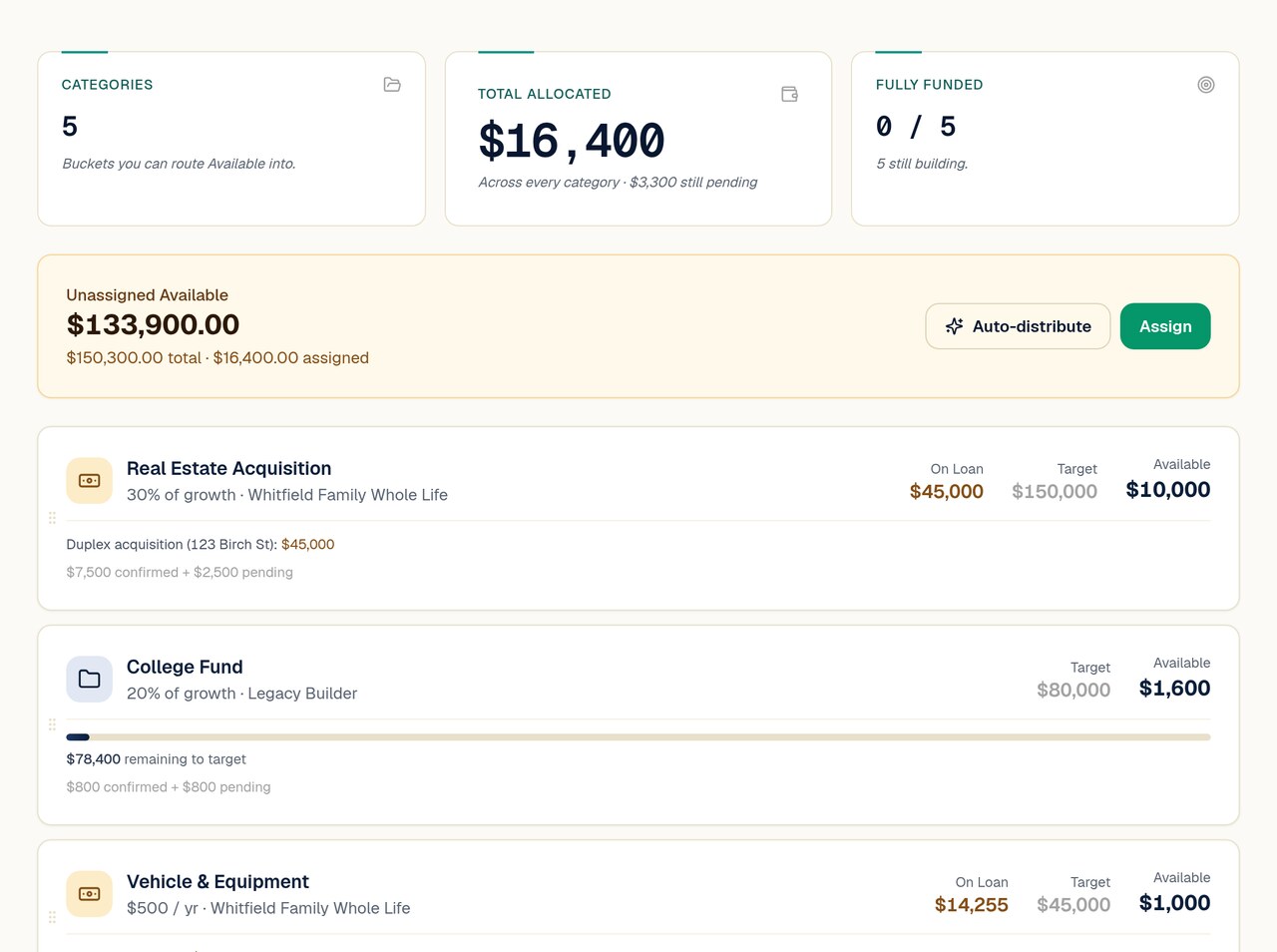
Zero-based budgeting for what you can borrow: every dollar of available loan amount is assigned to a category — vehicle, real estate, college, reserves — or it sits there marked unassigned until you deal with it. A category draws on every policy you link to it, so a goal isn’t tied to whichever policy happens to hold enough, and a new policy’s capacity flows into the categories you already have. The money is earmarked, not withdrawn: it stays in the policy and keeps earning. What you repay is borrowable again.

Budget categories with targets and allocated amounts

Recurring expenses — first-class.

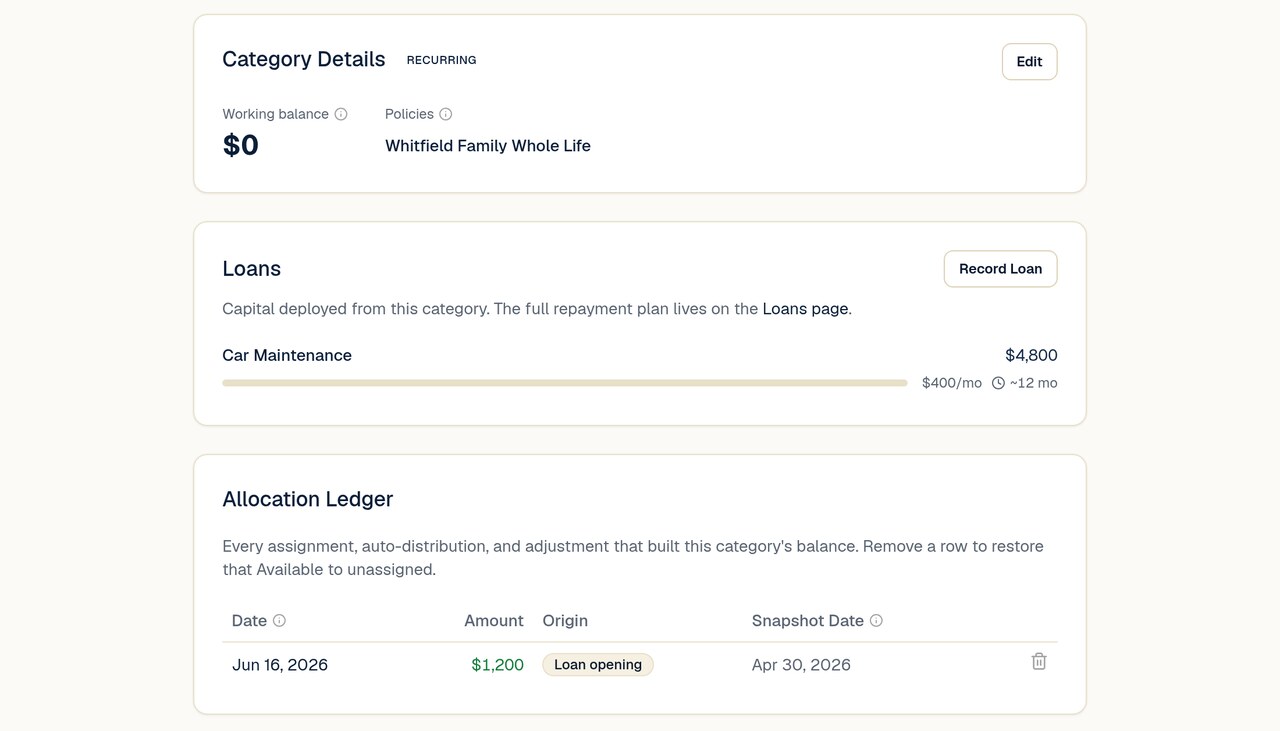
The classic Becoming Your Own Banker car purchase example, built in — and not just the car. Tuition, property taxes, registrations, maintenance, the annual premium itself: fund the category, borrow against it when the bill lands, put the redirected PUA toward the payments, and the category refills as the loan clears.

Recurring category with active loan and allocation history — car purchase loop

All your policy loans, managed in one place.

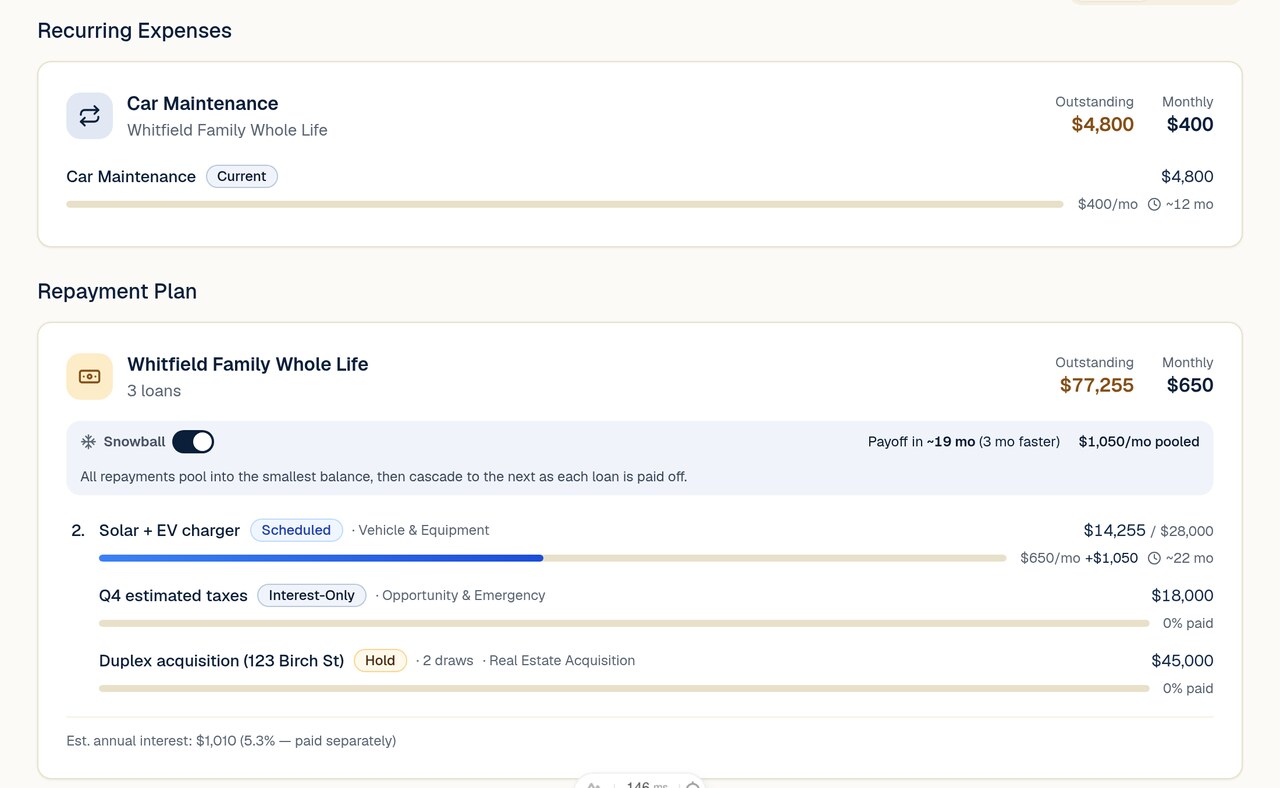
Be deliberate about repayment — or not: schedule it, interest-only, or hold until you’re ready. Category-aware when it matters, with balances, payments, draws, and snowball pooling in one place instead of a spreadsheet you stopped updating.

Policy loans with repayment strategies, balances, and monthly totals

Policy gotchas, before they cost you.

Interest that would capitalize, PUA room about to expire, riders and payments — you don’t keep a mental calendar. When something needs attention, it shows up:

  • Interest about to capitalize onto a loan
  • PUA room you’re behind on — with the catch-up amount
  • A PUA rider that will terminate unless you catch up
  • A loan paid off, so PUA can rise again
  • A premium you could finance instead of paying cash
  • A loan payment coming due
  • Policy numbers that have gone stale

Free during early access.

Every feature. No credit card.

Pricing

Free during early access.

Full product while we build with the first practitioners. Your feedback steers what ships next.

Early access

Everything included.

  • Unlimited policies, loans, and categories
  • Recurring expenses with PUA / loan split
  • Deadline and pace warnings built in
  • Statement upload and reconciliation

FAQ

Common questions.

Not yet. Upload statements or portal PDFs, or type the numbers in — your insurance company logins stay with you. Direct integrations are on the roadmap.
Encrypted in transit and at rest. No insurance-company credentials stored. No third-party analytics on your financial data. Export anytime.
Yes — dividend-paying whole life is the base of Infinite Banking. If you’re shopping for a policy, work with someone who designs IBC policies.
Nelson Nash’s approach: use whole life as your personal bank — borrow against cash value instead of from a bank.
No. IBC Tool is independent — not affiliated with or endorsed by the Nelson Nash Institute or Infinite Banking Concepts, LLC. The Infinite Banking Concept® is a registered trademark of Infinite Banking Concepts, LLC.

The usual line is “buy term and invest the difference” — term costs less, so more is left to invest. Independent work (including Ernst & Young Monte Carlo modeling) has challenged that over long horizons: permanent life can beat fixed income, term premiums drag a portfolio, and policy loans avoid forced sales in a downturn.

IBC doesn’t treat whole life as the investment. It’s savings plus a banking system. The question is who controls your capital. A policy loan uses cash value as collateral — it isn’t a withdrawal — so the balance keeps earning while you deploy the money elsewhere. Interest that would have gone to a bank stays in your system.

An IBC-designed policy (with Paid-Up Addition riders) also isn’t the plain whole life that critique usually targets: more early cash value, more accessible capital. Most practitioners still invest outside the policy; they finance those moves through the policy first so the same dollar works in two places.

Stop running IBC from a spreadsheet.

Free during early access.